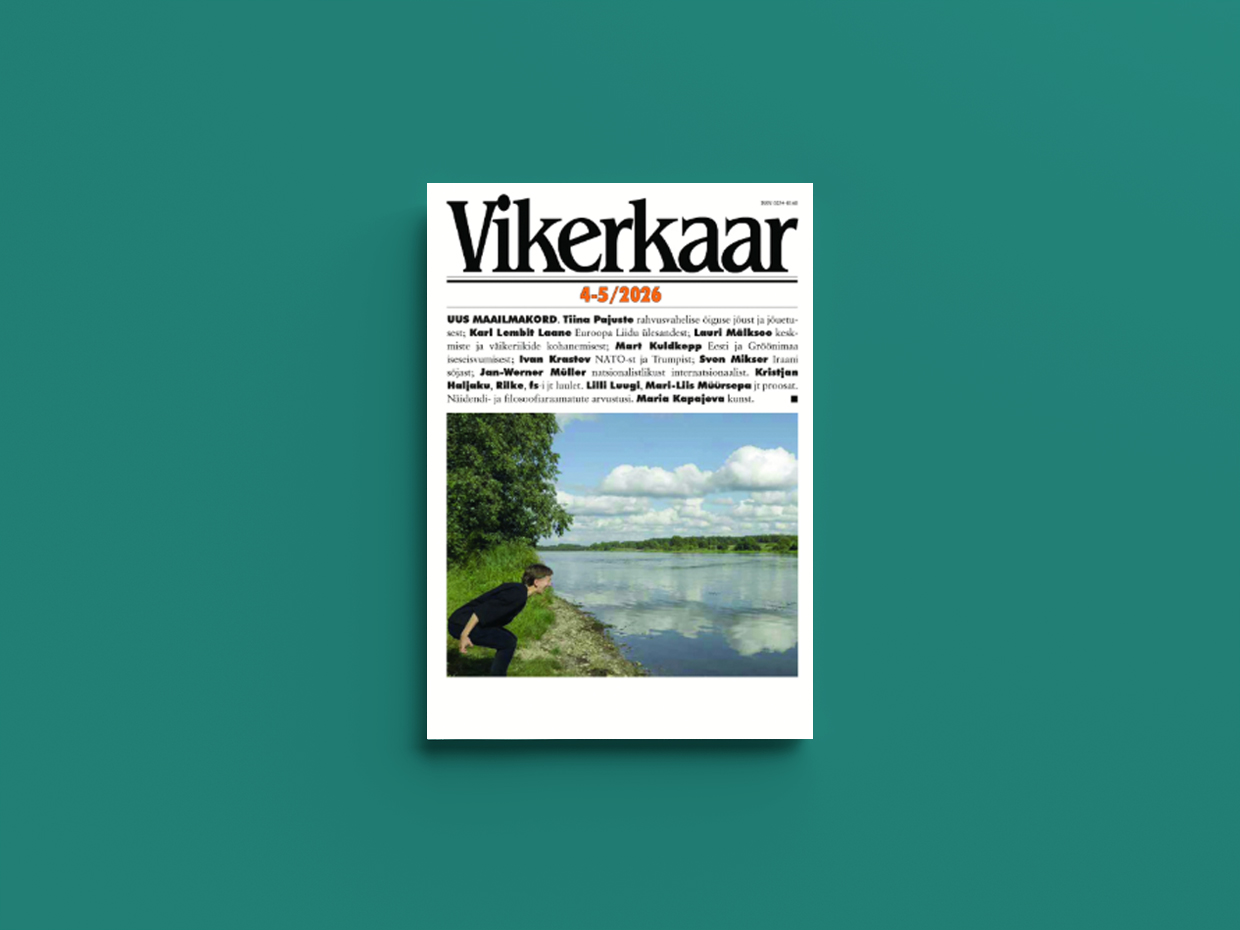
At Davos in January, Canadian PM Mark Carney compared the state of the international rules-based order to communism in 1970s Czechoslovakia: little more than a set of slogans long devoid of meaning. To avoid returning to a world in which, as Thucydides put it, ‘the strong do what they can and the weak suffer what they must’, the ‘less powerful’ countries of the world need to acknowledge this reality, according to Carney.
In Estonia, a small country with a long history of being a pawn in the geopolitical games of great powers, this call rings particularly urgent. The latest issue of Vikerkaar looks behind the empty slogans and asks what is left of the liberal international order, and how small states can survive and thrive in whatever might replace it.
Hypocrisies of the international order
Estonians recall how the Soviet Union regularly interfered in the affairs of states it considered to be in its ‘sphere of interest’, in Hungary in 1956 and in Czechoslovakia in 1968. But less known in these parts of the world is that the United States did the same in its ‘near abroad’ from Guatemala (1954) and Brazil (1964) to Chile (1973) and Nicaragua (1980s).
But the fact that the liberal rules-based order always contained a certain amount of hypocrisy does not mean it was simply a fiction, writes international relations scholar Tiina Pajuste. ‘Even when rules are broken, it is generally not done simply by publicly denouncing the rules of international relations, but by re-interpreting or re-phrasing them … From this perspective, the rules-based order cannot be considered a failure.’
Recalling the egregious violations of international law during George W. Bush’ presidency, Karl Lembit Laane argues that Donald Trump’s presidency reveals an embarrasing truth: ‘that the selective application of international law seems to bother most politicians in the West, including in Estonia, only now that we ourselves have become its next potential victims’.
Giving in to great power politics and openly aligning ourselves with one of the players is a bad idea, Laane argues, not least because none of the big players have shown themselves to be reliable partners. Instead, he endorses Carney’s proposal to empower the European Union as a bloc that prioritizes democracy and international law.
The EU, however, is a long way away from being able to fulfil such a role. The answer, for Laane, is federation. Only this path would, he argues, would enable the EU to evolve into an actor that is politically, technologically and militarily strong enough to hold its own against the illiberal alliance.
Small states in a big game
Mart Kuldkepp asks what lessons Greenland’s history offers small nations of the world such as Estonia. Greenland’s push for decolonization and Estonia’s emergence from colonial rule in 1918 reveal the importance of dealing with the hard realities that underlie idealistic slogans: self-determination needs to be enacted in practice, through expertise, capacity, and often military force.
‘Even if Greenland achieves full independence, questions about economic sustainability, administrative capacity, transport infrastructure, energy, budgeting, security and relations with Denmark and the US will still need to be addressed. As it moves towards greater autonomy, Greenland appears not simply as a constitutional dispute, but as a political challenge. The outcome will show whether the right to self-determination can, under extremely asymmetrical circumstances, be institutionalized and made permanent.’
Given Greenland’s reliance on subsidies from Copenhagen (to the tune of 4.5 billion kroner), the effects of climate change and discovery of new natural resource deposits, the question of autonomy involves asking ‘what part of Greenland’s habitual way of life can be preserved in this process, and what would have to be replaced by something else’.
Many other powers also have designs on the region, which Greenland has to diplomatically navigate – with an administrative capacity of a small European town (the island’s population is around 56k). Greenland’s present, much like Estonia’s past, reminds us that liberal values and democratic aspirations need to be grounded in real resources and power.
No method in Trump’s madness
Jan-Werner Müller sketches connections and comparisons between Donald Trump’s brand of far-right populism and the versions more common in Europe – most notably in Hungary, where Viktor Orbán was just voted out of power. Though the Trump administration has clearly attempted to copy the Orbán playbook, it has only been partially successful, Müller tells editor Aro Velmet.
‘Overall, I think we’re seeing a pattern that is pretty similar. If anything, what might be different is that the US right now still seems to lack personnel for doing things in a very systematic way. Going back to 2010–2011, Orbán was saying he was going to create a new national system – not to say that it completely succeeded, but he had a lot of resources to draw on in terms of experienced administrators and people who had their own ambitions. But even then, it still took a fair while before they figured out, for instance, how to transform universities into foundations with a view to capturing and subordinating them.’
Review by Aro Velmet
