
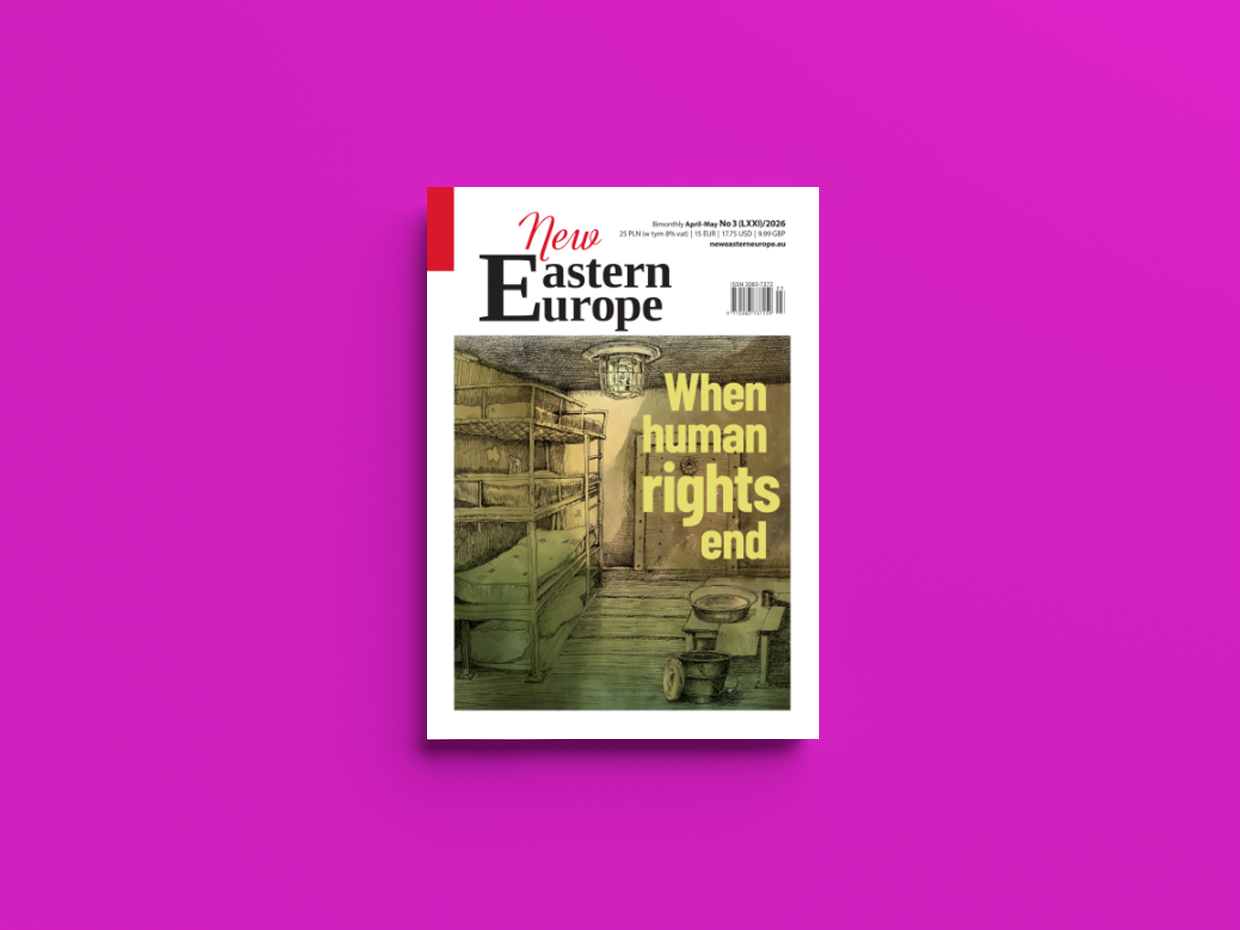
Marking the 50th anniversary of the formation of the first waves of Helsinki monitoring groups in Moscow, Ukraine and Lithuania, New Eastern Europe devotes its new issue to human rights.
These early initiatives set a precedent for others across the USSR and Central and Eastern Europe, affirming that the treatment of individuals within states was a matter of legitimate international interest. But today, the world appears to be sliding into a new era of might-is-right realpolitik that treats legal institutions and human rights as dispensable. In the introduction to the issue, the editors note ‘the growing tendency to subordinate human rights to national interests and the securitization of state policy’.
Why human rights still matter
Barbora Bukovská, senior director of law and policy at ARTICLE 19, urges us not to lose sight of the fact that human rights are a vital tool of accountability, perhaps more than ever. Coming from those eager to sideline rights in favour of business or security, the question whether human rights still matter echoes the rhetoric of authoritarian regimes and ‘belongs to a world that has already lost its moral nerve’, she writes.
For decades the world has turned a blind eye to the hypocrisy of international law and human rights enforcement in favour of deregulation and globalization, deepening inequality and concentrating wealth. This weakness has only been exacerbated by the climate crisis: ‘rights to water, health, housing and education are often ignored as political debates put economic growth or national interests before human needs’.
Politically, writes Bukovská, we must insist on the recognition of human rights as a check on abuses of power. Economically, we need to recognize that economic and corporate power is subject to the same limitations that were created for states. And on a human level, we must respect the dignity of others. ‘If the last century has taught us anything, it is that when people get tired of defending rights, it does not take long before they start losing them.’
Lukashenka’s war on women
Tatsiana Astrouskaya, research fellow at the Harvard Ukrainian Research Institute, describes how, by branding 2026 the ‘Year of the Belarusian Woman’, Alyaksandr Lukashenka’s regime in Belarus is instrumentalizing family policy under the banner of ‘traditional values’.
While Lukashenka has made family and social issues one of the pillars of state policy since he first came to power in 1994, the latest appeal ‘shows the regime’s growing obsession with stimulating birth rates’. Women constitute a clear majority of the Belarusian population (53.8% in 2025), so appealing to the female electorate has always been a logical move for Lukashenka.
He has courted favour through a range of state benefits for large families and even a state award for women who have given birth to and raised five or more children – though welfare policy ‘remains highly arbitrary and dependent on the president’s personal priorities and whims’. Meanwhile, sexist rhetoric, state–run beauty pageants and the repeated blocking of a law on domestic violence tell a different story.
The state’s increasingly repressive attitude towards women can be seen as a cynical reaction to the anti-regime protests of 2020, widely described as a ‘revolution with a female face’, in which women played a major role as both participants and leaders. The numbers of women who have since faced political persecution, including exile, imprisonment and forced labour, are in excess of Stalinist levels.
Burdening women – especially mothers – with endless responsibilities is a way for the regime to keep them out of the political arena, ensuring that they are less able to organize and resist, writes Astrouskaya. ‘It is a calculated and deeply cynical mechanism designed to ensure that a moment like 2020 does not happen again.’
Ukraine’s election dilemma
As Russia’s war on Ukraine moves deeper into its fifth year, debate about the possibility of holding elections in Ukraine is intensifying, despite constitutional barriers that prohibit elections under martial law.
Mariia Didkovska, project coordinator at the Kyiv-based Institute of American Studies, explains that the issue has been pushed into the spotlight by the US, which is threatening to withhold security guarantees if presidential elections are not held in Ukraine, along with a referendum on a peace deal. Meanwhile, the Kremlin continues to exploit the postponement of elections in Ukraine for propaganda purposes.
While Kyiv claims it is willing to make legal amendments to facilitate the process, ‘legislation alone cannot guarantee feasibility’, writes Didkovska. Rather, a halt in hostilities is required. While president Volodymyr Zelensky has suggested a 60-day ceasefire, Moscow says it will only consider a pause of 24 hours. Besides obtaining security guarantees that are both credible and enforceable, there are the practical questions of allowing freedom of movement, ensuring open information and campaigning, updating electoral data, and providing basic security conditions in and around polling stations.
There are also complex issues to consider if the outcome is to be representative and legitimate: how to organize voting for the millions of internally displaced citizens and refugees abroad, whose opportunity to vote ‘risks being constrained by limited voting infrastructure’; and how to ensure that members of the military have access to campaign information and can vote democratically. Then there is the matter of citizens in occupied territories – how could Ukrainians vote under Russian occupation? ‘The war has reshaped the electorate geographically, administratively and socially, and the system will have to respond accordingly.’
Didkovska suggests a number of solutions to these challenges, including digital innovation. Since it is highly unusual for elections to be held in countries where active combat is taking place, however, international institutions such as the OSCE may be reticent to participate in observation missions. ‘Ukraine confronts a dilemma that few modern democracies have faced on this scale: how to protect the integrity of the ballot while defending the survival of the state itself’.
Review by Alastair Gill
