
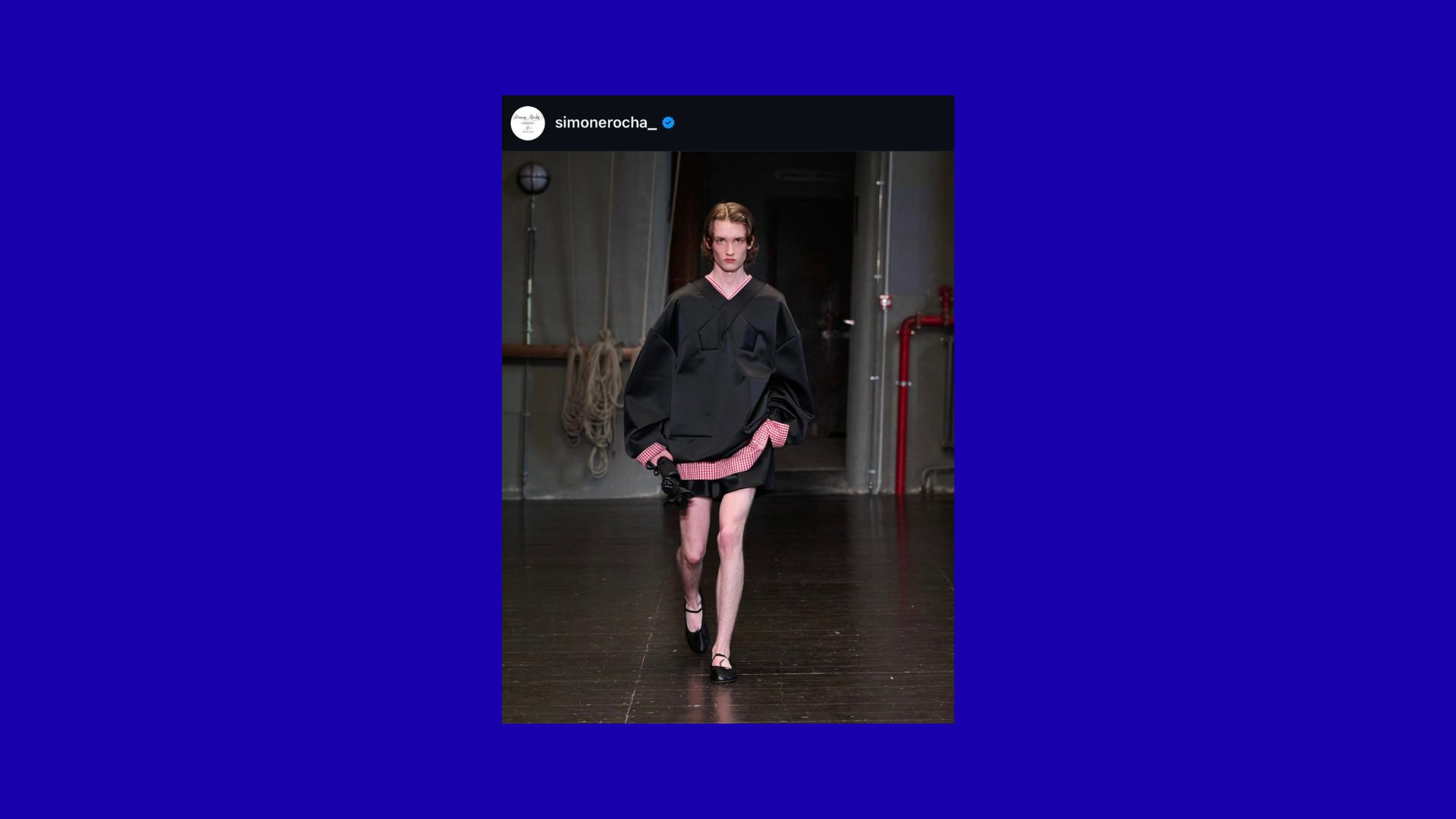
The Simone Rocha man is no stranger to us. We’ve been meeting him for the past three years, first folded into the women’s runway in 2023, then slowly separated out into his own lookbooks by 2025. A runway entirely to himself, though, is new territory. There’s always a first time for everything, people, places, even dress-up. In Italy, of course, even firsts come pre-loaded with a dash of romance. Which is to say: Florence’s Pitti Uomo just hosted Rocha’s first standalone menswear show.
Italy’s romantic gaze is hardly new. Rocha turns instead to the 20th century, when a young English girl met Florence and the idea of liberation that came bundled with its specific kind of romance, from E.M. Forster’s A Room With a View (1908) to its 1985 Merchant Ivory adaptation. In 2026, that girl becomes a boy. England loosens slightly in definition, and Florence does not. Rocha’s version of the story arrives at the Teatro della Pergola, commonly cited as the country’s oldest active opera house, through a 38-piece collection. Instead of occupying its red velvet seats, the designer left them completely empty. Of course, every show needs its guests, even in Italy. The stage became the runway, ringed by them.
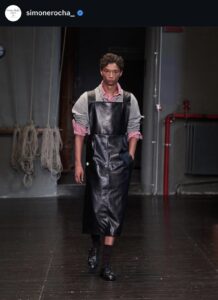
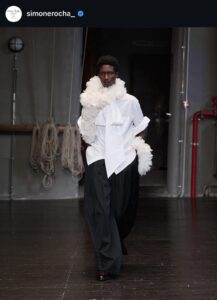
The collection, described by Rocha as a “character study”, seemed to be circling familiar menswear staples. Rugby shirts, roomy Oxford pants, glossy Oxford shoes (often broken by sharp appliqués), and crisp collars, nodding to the British Isles. Rocha’s man is, as expected, tender. That idea runs through the clothes: fragile tailoring, cotton aprons, Mary Janes, feather boas, glittering sequins, pearl buttons, and Edwardian ruffles (a useful point, perhaps, to revisit the film’s costume design).
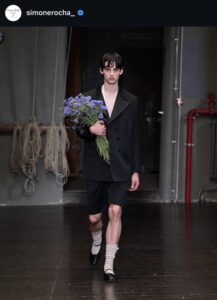
Florals hold everything in place. Sourced from the insides of the theatre’s costume trunks, they reappear across embroidery, accessories, even bouquets moving down the runway. Cornflowers, once dismissed as field weeds, were recast in Victorian England and Romantic-era Europe as “Bachelor’s Buttons”, worn by young men in love. A wilting flower was read as love gone unanswered, a strong bloom, as proof of devotion. Rocha’s devotion shows itself in this man’s shifting faces. One minute he’s classic, the next he’s softened, the other he’s a child again, playing with blooms. That in-between state of boyhood surfaces through boxer shorts, cravats, broderie anglaise, gingham, and ribbons moving across the runway. The boy is not finished becoming.
