
![6 of California’s Most Underrated Wine Regions [MAP]](https://vinepair.com/wp-content/uploads/2026/06/california-most-underrated-avas-social.jpg "6 of California’s Most Underrated Wine Regions [MAP]")
When thinking of California’s wine regions, Napa and Sonoma instantly come to mind. It’s understandable, as these well-regarded regions have longstanding prestige and churn out some of the world’s greatest wines. But Napa and Sonoma are so popular that they often eclipse the Golden State’s smaller, lesser-known regions.
Of the 279 established AVAs in the U.S., California is home to the overwhelming majority — 154 designated winemaking regions are located in the state. Why throw all of your eggs into two baskets when there are 152 more to explore? Beyond the rich, jammy Cabernet Sauvignons from Napa and Sonoma’s crisp, light-drinking Pinot Noirs, California’s under-the-radar AVAs offer a breadth of expressions and varieties to taste.
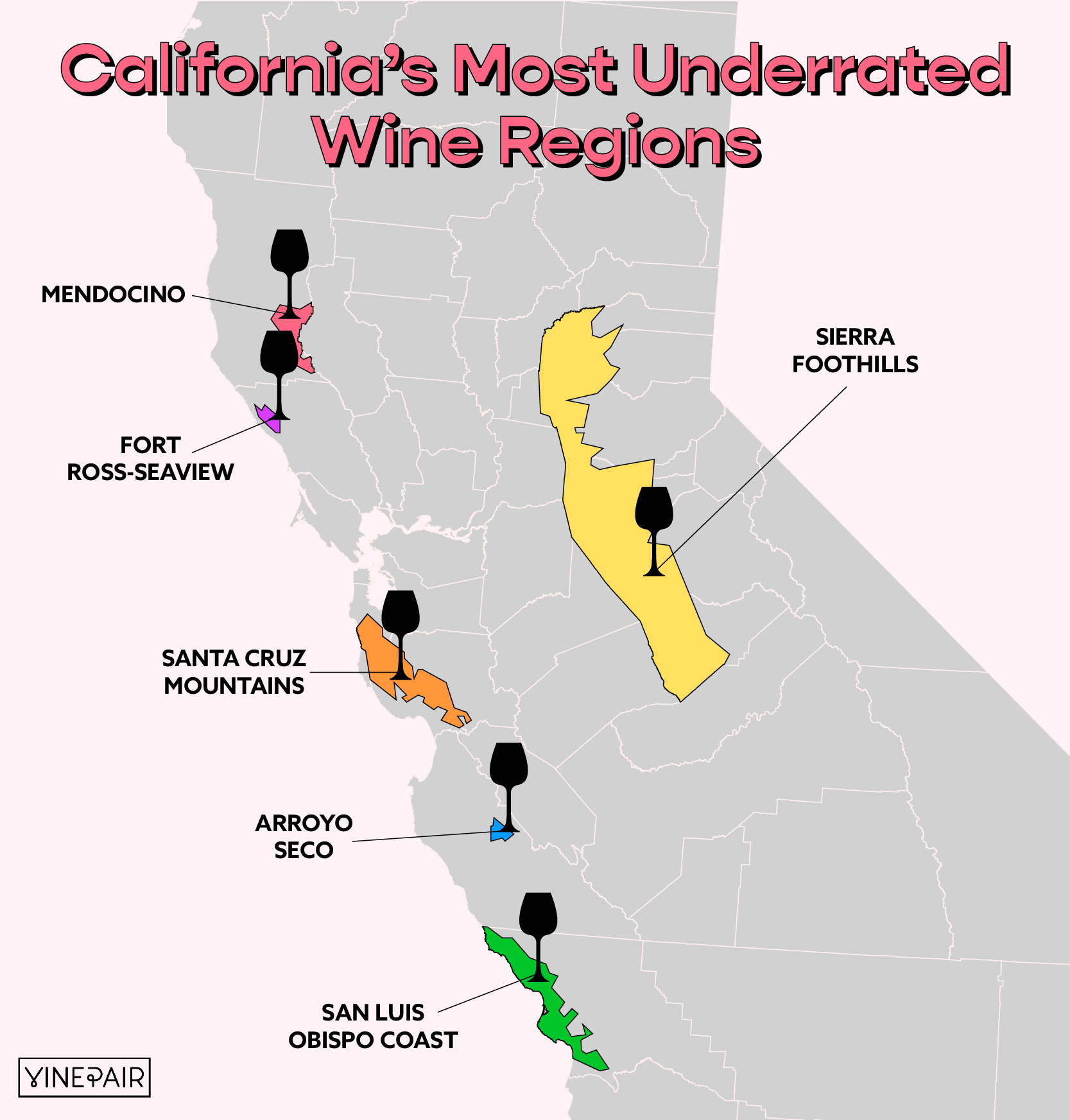
From the cool-climate, rugged hills of the North Coast down to the arid, inland plots next to the Sierra Mountains, here are six of California’s most underrated AVAs.
Arroyo Seco
Located in Monterey County on the Central Coast, Arroyo Seco, which translates to “dry riverbed,” gets its name from the eponymous river that trickles through the region. Arroyo Seco was officially established as an AVA in 1983, and is now acclaimed for its cool-climate Pinot Noirs and Chardonnays. At just 18,000 acres, Arroyo Seco is one of the smallest AVAs in the state and attracts limited-production and family-owned wineries. Vineyards planted in this region receive cooling, coastal winds — but not overwhelming gusts, as the Santa Lucia Mountains, which mark the western border, insulate some of the inland heat. Grown in gravelly soil and a temperate climate, Arroyo Seco wines are known for their zippy acidity and balanced fruit qualities. Renowned producers include Hobo Wine Company and McIntyre Family Wines.
Don’t Miss A Drop
Get the latest in beer, wine, and cocktail culture sent straight to your inbox.
Fort Ross-Seaview
Fort Ross-Seaview, situated west of Russian River Valley on the North Coast, is among the westernmost AVAs in California. When Sonoma Coast became an official AVA in 1987, it included this mountainous zone, which was later named an independent appellation in 2011 after years of winemakers fighting for the separate designation. Fort Ross-Seaview was established as its own AVA because of its unique, high-altitude terrain. It takes up around 27,500 acres of land, but only vineyards located 920 feet or more above sea level can label their wines as part of the appellation. The requirement — which was imposed to place plots above the coastal fog and in maximum sunlight — cuts the region’s cultivation area down to 550 acres. Vignerons can still farm below the fog, but their wines would fall under the Sonoma Coast AVA.
The coastal climate and rocky, sandstone soil in Fort Ross-Seaview make for an ideal environment in which to cultivate Burgundian varieties: Pinot Noir accounts for roughly 61 percent of the AVA’s acreage and Chardonnay another 31 percent. Two wineries that characterize the region are Arnot-Roberts and Hirsch Vineyards.
Mendocino
Mendocino, which became an AVA in 1984, is one of the 14 appellations in Mendocino County on the North Coast. Within it are a number of sub-AVAs like Cole Ranch, Potter Valley, and Redwood Valley. Some of the first winemakers to plant vinifera grapes in Mendocino were Italian settlers, who arrived en masse following the Gold Rush. Now, small-production vineyards make up the fabric of the area and grow a mixed bag of grapes: Expect anything from Zinfandel to Syrah to Charbono to Italian varieties. Lauded Alsatian whites and sparkling wines also come from Mendocino. What allows such a diverse set of grapes to grow well there is its varying soil types — ranging from alluvial loam to rocky sandstone — and mountainous topography.
Santa Cruz Mountains
Perched over Silicon Valley, the Santa Cruz Mountains AVA is at the intersection of the mountains themselves, the Pacific Ocean, and Monterey Bay. Grape cultivation began here as early as the 1870s, but it wasn’t recognized as an official AVA until 1981, when it became the first mountain range in California to be named a winemaking region. Big producers like Ridge, with its famed Monte Bello vineyard, cultivate here, but the area is also rife with small-production, indie winemakers producing stellar wines. Many of their plots lie above the fog line, resulting in cool-climate, high-acid expressions of Cabernet Sauvignon, Chardonnay, Merlot, and Pinot Noir. Among the region’s most celebrated producers are Farm Cottage and Madson Wines.
San Luis Obispo Coast
San Luis Obispo Coast — also known as SLO Coast — is notably different from San Luis Obispo (SLO) County. SLO Coast is just a 15-mile stretch of land with under 4,000 acres of vines, the majority of which are Chardonnay and Pinot Noir, whereas SLO County encompasses 18 different AVAs. It became an AVA in 2022, making it one of California’s most recently established winemaking zones. As the name suggests, the region lies along the coast of the Pacific Ocean, and the Santa Lucia Mountains mark its eastern border. With the mountain range blocking most inland heat and the Pacific Ocean bringing consistent sea breezes, SLO Coast’s temperatures are quite low, making it suitable for coastal grapes like Albariño and cool-climate varieties like Riesling. The result is wines with zippy acidity, mild fruit qualities, and easy-drinking, low-alcohol characteristics. Two producers championing the newly designated SLO Coast AVA are Brij Wines and Outward Potrero Vineyard.
Sierra Foothills
The Sierra Foothills AVA sits at the base of the Sierra Nevada Mountain Range. A surge of settlers came to the area in 1848 after the discovery of gold. This influx created a burgeoning wine industry around the mid-19th century, but it fell entirely flat after the onset of Prohibition. Luckily for curious winemakers in the 1970s, most of its warm-climate, high-altitude vineyards were simply abandoned, not uprooted. Sierra Foothills became an AVA in 1987, and since then, the region has produced full-bodied, teeth-kicking reds like Syrah and Zinfandel. Its rocky soil forces grapevines to grow their roots deep into the ground, producing fewer yet flavor-packed clusters. Warm days swept away by cool nights help the grapes preserve their acidity. Producers like Newfound Wines achieve that signature balance between jammy fruit and refreshing acidity.
*Image retrieved from haveseen via stock.adobe.com
