
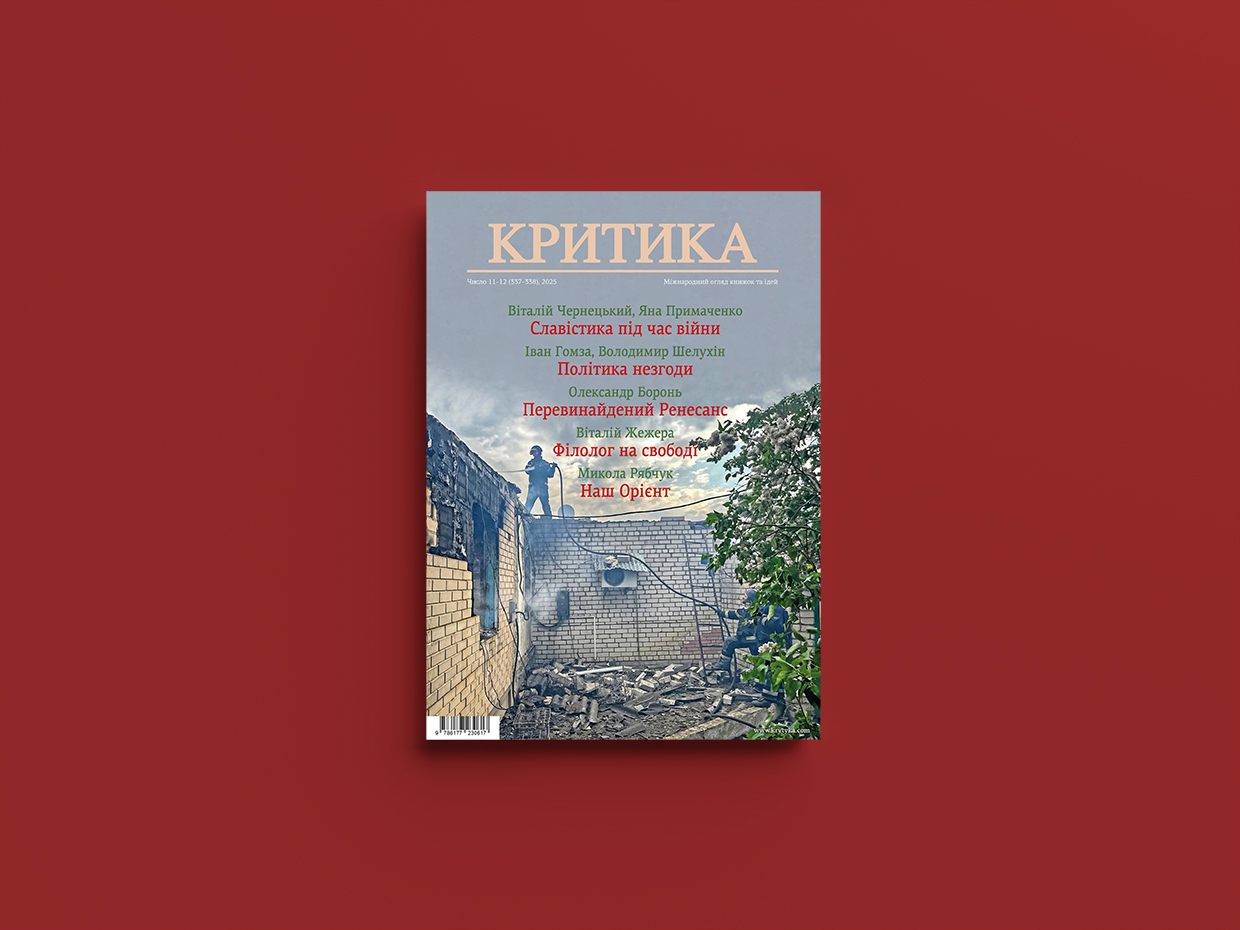
In Krytyka (Ukraine), political scientist Ivan Gomza and sociologist Volodymyr Shelukhin discuss democratic peace theory and its limits. Gomza dismantles the comfortable thesis that democracies do not fight one another. It is liberal democracies, embedded in norms of mutual respect and institutional constraint, that tend toward peace, and not democracies as such.
While civil liberties often erode under the pressure of constant military conflict, war can also accelerate democratisation, as seen with women’s enfranchisement after the First World War, offering a opportunity for rethinking how democracy functions and sustains itself.
Most major indexes rate Ukraine as an unconsolidated or hybrid democracy precisely because martial law has suspended elections – a methodological absurdity, comment Gomza and Shelukhin. On the contrary, the interaction between state institutions and civil society in wartime Ukraine demonstrates remarkable resilience. The mobilisation of resources through horizontal networks reveals that defence is no longer solely a state affair.
What matters is which actors shape the process, concludes Gomza. Regimes do not degenerate alone; elites and citizens choose directions.
Ambicoloniality
Yana Prymachenko reviews Svitlana Biedarieva’s book Ambicoloniality and War: The Russian-Ukrainian Case (2025). Russia’s centuries-long, gradual absorption of Ukrainian lands produced a relationship of mutual symbolic dependence, in which the coloniser drew so deeply on the colonised culture that it could no longer distinguish interior from exterior. In moving beyond the binary of coloniser and colonised, Biedarieva’s concept of ambicoloniality captures this process.
Prymachenko situates the book within a long Ukrainian intellectual tradition of naming colonial asymmetry, from Vasyl Shakhrai’s 1918 critique of Bolshevik nationality policy to Ivan Dziuba’s dissident Marxism. Each attempt to name the asymmetry was met with repression rather than argument, confirming, as Prymachenko observes, the colonial character of the relationship.
For Biedarieva, Russia’s desire for Ukraine functions in a psychoanalytic register, combining Eros and Thanatos: the compulsion to possess the object of desire shades into a compulsion to destroy it. ‘This structural ambivalence produces an affective logic of desire and violence’ that culminates in attempts to appropriate Ukrainian historical and symbolic resources.
Following the 2014 annexation of Crimea, Russia has actively sought to appropriate Ukraine’s historical heritage by erasing Kyiv’s foundational role in Orthodox Slavic history. Instead, Moscow has weaponized the history of Crimea – where Prince Volodymyr was baptized – to claim a direct spiritual lineage from Byzantium. The full-scale invasion extended this into what Achille Mbembe has referred to as ‘necropolitics’ – in this case, systematic physical, social, and symbolic destruction aimed at dismantling Ukrainian subjecthood entirely.
The Euromaidan was a point of no return, shattering the communicative model on which ambicolonial relations depended. Prymachenko notes that Russian scholars have long deployed the concept of internal colonisation to dissolve the Holodomor into an all-Union famine – a move Biedarieva’s framework unmasks by showing that this supposedly ‘internal’ process always maintained a hierarchy between the imperial centre and the colonised periphery.
The imagined Orient
In the sealed Soviet society of the 1970s, a circle of cultural dissenters found in Asian literature and philosophy a resource that ideology could not colonise, writes Mykola Riabchuk in a personal essay originally published in Japanese. Persian Sufi poetry, Japanese haiku, Hermann Hesse’s Siddhartha: these constituted ‘our Bible, our Quran and our Short Course in Marxism–Leninism.’ The essay charts how this ‘imagined Orient’ served to fill an ontological gap – providing existential bearings that neither official communist ideology nor the state-controlled Orthodox Church could offer.
The essay pivots to his residence at Hokkaido University in 2024, where the imaginary gives way to the real in a small surprises: ambulance sirens uncannily close to air-raid warnings; a stranger at a suburban train station who, unable to explain the route in words, runs ahead through tunnels and up stairwells to point out the correct platform. Riabchuk’s curiosity is his method: ‘I discovered all these wonders entirely by chance, being a specialist in neither cinema nor literature nor even history; what drove me was pure curiosity – a desire to understand this land and its people better.’
The essay closes with a diplomatic argument wrapped in memoir. Japan is Ukraine’s seventh-largest donor, a contribution underreported in Ukrainian media because it carries no military component. But cultural diplomacy must go both ways: a handful of Ukrainian books on Amazon Japan is not enough. Political emancipation, Riabchuk insists, must be accompanied by cultural and epistemological liberation. ‘Our ancient journeys to the East are acquiring unexpected forms and contents. Lets not stop.’
A philologist at play
Vitalii Zhezhera, editor-in-chief of theatre journal Ukrainskyi Teatr, takes up three posthumously published prose volumes by the late Ukrainian literary scholar, folklorist, and writer Stanislav Rosovetsky (1945—2002).
While the novel A Brutal Kyivan Romance is strikingly prophetic – written in 2012, two years before Euromaidan, yet containing tanks on Pechersk and cruise missiles flying in from the East – it is Rosovetsky’s language that primarily interests Zhezhera.
Rosovetsky was a bilingual who grew up in a Russian-speaking environment and trained in Russian philology. All three books carry a significant residue of Russian lexical and syntactic interference. Zhezhera reframes this linguistic hybridity as an assertion of creative identity rather than a failure of craft: ‘It seems that Rosovetsky wrote his fiction rapidly, giving himself no time to search for the right words or turns of phrase: he used whatever was at hand and edited later, if he got round to it.’
This approach allowed Rosovetsky to forget about the framework of philology and instead to remain connected to the linguistic environment of his youth, ‘drawing from a well of vernacular that lives in the soul’.
Review by Kseniya Kharchenko
