

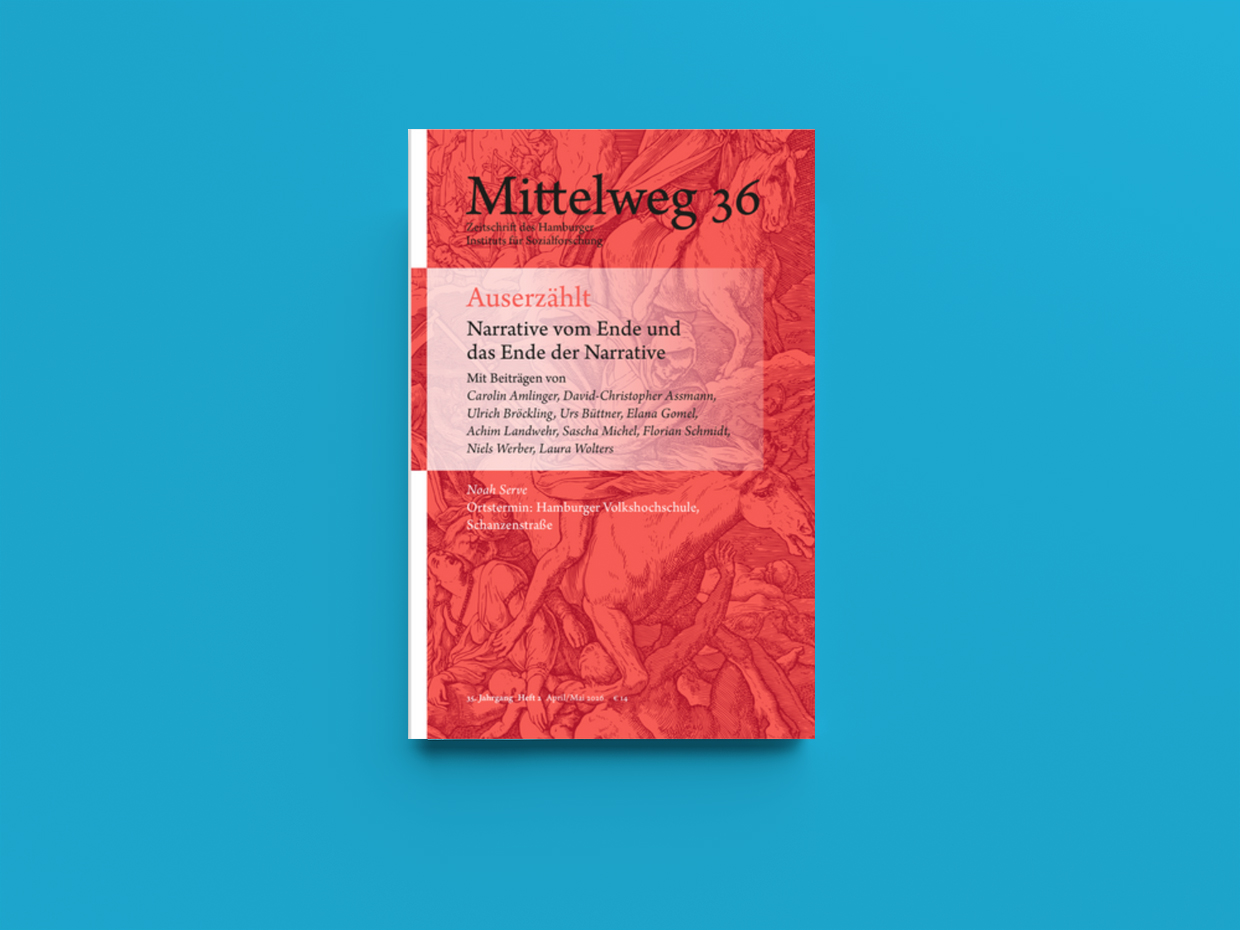
Narratives of Apocalypse are a defining feature of the present. In parallel, narrative itself is in decline, or even obsolete, according to many thinkers. Mittelweg 36 examines the paradox: ‘Why has the end-times narrative become popular precisely when narrative itself seems to be ending?’
The perceived crisis of narrative is tied to broader diagnoses of late modernity, write the issue editors. Shared historical horizons and collective projects have dissolved into fragmented streams of information, while contemporary culture displays a conservative preference for the ‘reproduction of familiar patterns’. The result is ‘an omnipresence of small, meaningless narratives’ with no grand narrative capable of inspiring consensus.
At the same time, apocalyptic thinking permeates society. Climate collapse, democratic erosion, technological acceleration and war are increasingly interpreted in terms of irreversible breakdown. The Apocalypse functions less as a religious motif than a cultural structure for organizing uncertainty. ‘End-times narratives sidestep certain problematic aspects of storytelling’, including its teleological orientation, its false claim to realism and its assumption of causality.
Today’s cluster of crises are woven into narratives that promise to make sense of chaos by imagining an end point. Even claims that society has entered a ‘post-narrative’ age rely on a narrative of decline and exhaustion. The end of storytelling itself becomes one more story about the end, a recursive structure in which narrative survives by narrating its own disappearance.
Narrative vacuum
A German thinktank recently claimed that narratives help to ‘reduce complexity, guide current and future-oriented strategies, encourage cooperation and increase predictability’. But when politicians in the Bundestag invoke narratives, whether ‘pro-Russian or anti-Semitic narratives’ or ‘the narrative of a green transformation’, they rarely provide any information about their content.
This inflationary use of the term is problematic, argues literary scholar Niels Werber. If, in a traditional concept of narrative, meaning emerges from the ordering of events, contemporary ‘narratives’ are more like placeholders for meaning intended to evoke an emotional response.
Werber contrasts enduring narratives, which provide ‘purpose, stability and direction’, with the fleeting logic of platform capitalism, where ‘storytelling is story-selling’. The demands of the attention economy create a narrative vacuum filled with ephemeral snippets designed to stimulate consumption.
The result of this hollowing out of narrative is the rise of an ‘unpredictable, discontinuous, unforeseeable’ form of politics characterized by chaos and volatility. Social movements flare up like mindless swarms in response to ‘brief, powerful stimuli’ and die away before they can have any lasting impact. In our atomized, algorithmic society, current affairs are reduced to a kind of Brownian motion: they can be statistically modelled, but not sociologically explained.
Zombie fiction
If fictional monsters are ‘metaphors that express the underlying fears and anxieties of their culture’, what fear is expressed by the twenty-first century’s favourite monster, the zombie?
Literary scholar Elana Gomel suggests that these undead hordes without agency or speech reveal fear of ‘the way language becomes decoupled from meaning in the age of the mass media and the internet’. Unlike vampires or aliens, zombies are fundamentally repetitive and ‘anti-narrative’: zombie fiction depicts relentless waves of attacks, ‘a potentially endless chain of confrontations, with each new episode repeating the basic pattern rather than functioning as a step toward closure’.
This structure transforms the traditional apocalyptic narrative inherited from the Book of Revelation, which moves from catastrophe to rebirth via the revelation of hidden knowledge. Zombie fiction suspends this process indefinitely, replacing revelation and salvation with endless continuation. ‘Rather than yet another apocalyptic narrative, the zombie invasion is an apocalypse of narrative’.
For Gomel, the zombie virus is a metaphor for language itself: endlessly replicating, detached from intention and spreading like digital information: ‘Precisely because the zombie is a blank entity, it can serve as a stand-in for loss of referentiality in discourse’. Ultimately, zombie fiction reflects a culture dominated by digital media in which narratives no longer reveal stable truths or provide meaningful closure, but endlessly circulate, reproduce and consume themselves.
Teleology and porosity
Robert Musil observed in A Man Without Qualities that ‘it would be an uncanny world if events simply slunk off’ without some final confirmation that they had truly happened. Historian Achim Landwehr argues that this all-too human desire for neat endings shapes dominant historical narratives, which are structured by teleological assumptions. Because beginnings are only recognizable retrospectively, ‘the end is the beginning of historical narration’.
From Hegel and Marx to Spengler and Fukuyama, modern historiography imagines history in reverse as a progression toward some final resolution. The discourse of the Anthropocene reproduces this logic, presenting climate crisis as both an apocalyptic endpoint and the culmination of modernity’s faith in progress. Yet it is precisely these ‘collective singular, unilinear, causal-logical and teleological’ forms of historical narration that helped produce the Anthropocene itself.
At the same time, the Anthropocene destabilizes such narratives because ecological crisis unfolds across vast and overlapping temporal scales that resist linear storytelling. To rethink this problem, Landwehr turns to the idea of ‘porosity’ developed by German intellectuals living in Naples during the hyperinflation crisis of the 1920s. In their writings, Naples appeared porous because boundaries between public and private, old and new, constantly dissolved into one another.
For Landwehr, porosity becomes a model for ‘a mode of thinking that is anti-systematic and open to interpretative connections’: rather than treating epochs as sealed and linear, historians should recognize that temporalities overlap and persist within one another. He therefore advocates a more descriptive, ‘nebulous historiography’ with a focus on surface-level complexity and open-endedness rather than coherence and closure.
Review by Cadenza Academic Translations
